

|
|
DID JOSHUA DESTROY THE CANAANITES
THE WALLS OF JERICHO FELL OUTWARDS
http://www.bibleprobe.com/jericho.htm
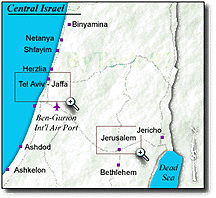
While excavating in and around Jericho between 1930 and 1936, Prof. John Garstang wrote, "As to the main fact, then, there remains no doubt: the walls [of the city] fell outwards so completely that the attackers would be able to clamber up and over their ruins into the city." In addition to writing this independent description of this one particular find, he also signed it and had two of his co-workers witness and sign it themselves
Why did he feel it necessary to emphasize the authenticity of this statement to such a degree? Because the evidence from every other archeological site around the ancient cities of the Middle East always showed the walls of the cities always fell inward. Every single one except, of course, Jericho's. They all fell inward rather than out for a very simple reason: when attackers besiege a city they are typically trying to get in, not out. And yet Jericho's walls clearly fell outward.
The reason for this can be found in the biblical account of the fall of Jericho when God caused the walls to "fall down flat" allowing Joshua's army to seize the city. (Joshua 6:1-20)
March 27, 1999 Jericho -
The Walls DID Come Tumbling Down!
Gary Byers
In the spring of 1997, two Italian archaeologists conducted a limited excavation on the ancient tell of Jericho. Lorenzo Nigro and Nicolo Marchetti, working under the auspices of the new Palestinian Department of Archaeology, excavated for one month on the fringes of Kathleen Kenyon’s west and south trenches. Their dig was the first foreign expedition in the Palestinian-controlled areas of the West Bank since self-rule began in 1994.
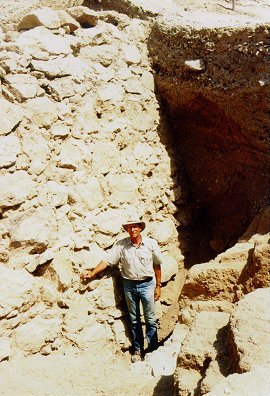
ABR's Bryant Wood standing beside a section of the collapsed wall of Jericho.
After their excavation, Nigro and Marchetti announced they found no evidence for a destruction from the time of Joshua. While it is too soon for the academic community to see details of their discoveries, their announcement suggests their excavation was conducted to disprove the Biblical account of Joshua’s capture of the city. Is it further possible that the Palestinian Authority supported this dig for the express purpose of denouncing any Jewish connection to the site?
As to their evidence, Dr. Bryant Wood, Director of the Associates for Biblical Research and one of the leading experts on the archaeology of Jericho, recently responded. "It matters little what the Italian archaeologists did not find in their month-long dig. The evidence is already in. Three major expeditions to the site over the past 90 years uncovered abundant evidence to support the Biblical account," he said. As Wood went on to point out, John Garstang (l 930-1936) and Kathleen Kenyon (1952-1958) both dug at Jericho for six seasons and a German excavation directed by Ernst Sellin and Carl Watzinger dug for three. All found abundant evidence of the city’s destruction by fire in a layer related to the Biblical date of 1400 BC.
In September 1997, Dr. Wood visited Jericho and examined the results of the Italian excavation first hand. Incredibly, he found the Italians had uncovered the stone outer revetment wall at the base of the tell with part of the mud brick wall built on top of it still intact. In the balk of the Italian excavation, at the outer base of the revetment wall, Wood noticed the remains of the collapsed mud brick city walls which had tumbled. Not only did the Italians find the same evidence uncovered in the earlier excavations, it fits the Biblical story perfectly!
"The Italian excavation actually uncovered most of the critical evidence relating to the Biblical story," said Wood. "But even more exciting is the fact that all the evidence from the earlier digs has disappeared over time. We only have records, drawing and photos. But the Italians uncovered a completely new section of the wall which we did not know still existed. I had my photograph taken standing next to the wall where the mud brick collapse had just been excavated!"
Unfortunately, the Italian archaeologists, the Palestinian Authorities, the Associated Press and most of the world doesn’t realize any of this. It is a sad commentary on the state of archaeology in the Holy Land, when the purpose of an excavation at a Biblical site is to disprove the Bible and disassociate the site with any historical Jewish connection.
But that’s why the Associates for Biblical Research is in business. Please pray our efforts. Pray for the removal of all obstacles blocking the publication of Dr. Wood’s technical study of the pottery of Jericho. Please pray for the continued field work ABR sponsors in Israel. Please pray for our daily efforts in presenting this truth to the world.
GOD
COMMANDED THE ISRAELITES TO CONQUER THE LAND OF CANAAN AND DESTROY ITS
INHABITANTS INCLUDING THE CANAANITES - BUT NOT ALL WERE DESTROYED
The biblical
account suggests that while Joshua was commanded to destroy the
Canaanites, he did not completely eliminate them, as some remained in
the land.
In the book of Joshua, God commanded the Israelites to conquer the land
of Canaan and destroy its inhabitants, including the Canaanites, as
part of their divine mandate (Deuteronomy 20:16-17). Joshua is
described as having conquered various regions and claimed to have left
"none remaining" (Joshua 10:40). However, the narrative also indicates
that not all Canaanites were driven out. For instance, Judges 1:28
states that the Israelites "did not completely drive them out," and in
other instances, specific groups like the Jebusites continued to
inhabit Jerusalem (Judges 1:21).
FALL OF JERICHO, CONTINUED: PART OF THE CONQUEST OF CANAAN
The fall of Jericho, as described in the biblical Book of Joshua, was the first military engagement fought by the Israelites in the course of the conquest of Canaan. According to Joshua 6:1–27, the walls of Jericho fell after the Israelites marched around the city walls once a day for six days, seven times on the seventh day, with the priests blowing their horns daily and the people shouting on the last day. Excavations at Tell es-Sultan, the biblical Jericho, have found evidence of a city at the relevant time (end of the Bronze Age),[2].
BIBLICAL ACCOUNT AGREES WITH ARCHEOLOGY
According to the Book of Joshua, when the Israelites were encamped at
Shittim opposite Jericho, ready to cross the river, Joshua, as a final
preparation, sent out two spies to Jericho. The spies stayed in the
house of Rahab, a local prostitute. The king of Jericho sent soldiers
who asked Rahab to bring out the spies. Instead, she hid them under
bundles of flax on the roof. After escaping, the spies promised to
spare Rahab and her family after taking the city, if she would mark her
house by hanging a red cord out the window.
After the Israelites crossed the Jordan, the king of Jericho ordered
that the gates of the walls be closed. God commanded Joshua to go
around the walls of Jericho for six days, once every day, and seven
times on the seventh day. God commanded the city to be attacked by
seven priests blowing horns, with the Ark of the Covenant in front of
them and all the people behind the Ark of the Covenant. They encircled
the wall of Jericho once a day for the first six days, and then
encircled the city seven times on the seventh day. After the shofar
(horn) sounded a great blow, the Israelites shouted, and the city walls
fell beneath them.
Following God's law, the Israelites killed every man and woman, the young and the old, as well as the oxen, sheep, and donkeys. Only Rahab, her parents, brothers and all "those who belonged to her" were spared. They were incorporated into Israel. Joshua then cursed anybody who rebuilt the foundations and gates, with the deaths of their firstborn and youngest child respectively. This was eventually fulfilled by Hiel the Bethelite under King Ahab's reign.
ORIGINS AND HISTORICITY
DEPICTION OF THE BATTLE BY JEAN FOUQUET (C. 1415-1420)
EXCAVATIONS AT TELL EX-SULTAN
In 1868, Charles Warren identified Tell es-Sultan as the site of biblical Jericho.[4] Ernst Sellin and Carl Watzinger excavated the site between 1907 and 1909 and in 1911, finding the remains of two walls which they initially suggested supported the biblical account of the Battle of Jericho. They later revised this conclusion and dated their finds to the Middle Bronze Age (1950–1550 BCE).[5] In 1930–1936, John Garstang conducted excavations there and discovered the remains of a network of collapsed walls which he dated to about 1400 BCE. Kathleen Kenyon re-excavated the site over 1952–1958 and demonstrated that the destruction occurred at an earlier time, during a well-attested Egyptian campaign against the Hyksos of that period, and that Jericho had been deserted throughout the mid-late 13th century BCE, the supposed time of Joshua's battle.[6] Sources differ as to what date Kenyon instead proposed; either c. 1500 BCE[6] or c. 1580 BCE.[7] Kenyon's work was corroborated in 1995 by radiocarbon tests which dated the destruction level to the late 17th or 16th centuries BCE.[7] Although this destruction is dated to 16th century by carbon dating, scholars propose that this destruction could be ascribed to either Ahmose I(1549-1524 BCE), whose royal signet was found in the necropolis in a slightly later LB I tomb, or Tuthmose III(1479-1425 BCE), whose scarab was recovered from a cemetery northwest of Jericho.[8] A small unwalled settlement was rebuilt after the destruction, but it has been agreed that the tell was unoccupied until the 10th/9th centuries BCE.[9]
More recently, Lorenzo Nigro from the Italian-Palestinian Expedition to
Tell es-Sultan has argued that there was some sort of settlement at the
site during the 14th and 13th centuries BCE.[2] He states that the
expedition has detected Late Bronze II layers in several parts of the
tell, although its top layers were heavily cut by levelling operations
during the Iron Age, which explains the scarcity of 13th century
materials.[10] Nigro says that the idea that the Biblical account
should have a literal archaeological correspondence is erroneous, and
"any attempt to seriously identify something on the ground with
biblical personages and their acts" is hazardous.[11]
In 2023, Nigro confirmed that Jericho was occupied in the Late Bronze
Age (1400–1200 BCE).[12] During this period, the previous Middle Bronze
city wall was refurbished by adding a mudbrick wall on top of its
emerging crest.[12]: 602 The city also had a structure known as the
"Middle Building" which apparently served as the residence of its local
rulers, then vassals of the Egyptian empire.[12]: 605 There also
appears to be evidence that the Middle Building was eventually
destroyed, only being reused later in the early Iron Age.[13]
The Siege of Jericho, in a Nestorian Christian plate made by
Sogdian artists under Karluk dominion, in Semirechye.[14] Cast silver
of the 9th-10th century, copied from an original 8th century
plate.[15][16]
ACADEMIC CONSENSUS
A minority of scholars maintain that the biblical account is historical
and that an Israelite conquest of Jericho may have occurred around the
13th century BCE,[17][18] but the strong consensus among scholars is
that the Book of Joshua holds little historical value.[19] Its origin
lies in a time far removed from the times that it depicts,[20] and its
intention is primarily theological in detailing how Israel and her
leaders are judged by their obedience to the teachings and laws (the
covenant) set down in the Book of Deuteronomy.[21] The story of Jericho
and the rest of the conquest represents the nationalist propaganda of
the Kingdom of Judah and their claims to the territory of the Kingdom
of Israel after 722 BCE;[3] and that those chapters were later
incorporated into an early form of Joshua likely written late in the
reign of King Josiah (reigned 640–609 BCE), and the book was revised
and completed after the fall of Jerusalem to the Babylonians in 586
BCE, and possibly after the return from the Babylonian exile in 538
BCE.[22]
On the other hand there is substantial evidence supporting the biblical account of
Joshua's conquest of Canaan, particularly regarding the destruction of
cities like Jericho, Ali, and Hazor.
Archaeological findings, such as local Canaanite pottery and ash deposits, indicate a massive destruction of cities around the time of Joshua, consistent with biblical accounts.
The biblical narrative describes a path of utter
destruction across the Promised Land, which has been supported by
archaeological evidence, although some cities may have been preserved.
The destruction of Jericho, Ai, and Hazor has been
documented, with evidence of heavy burning and ash deposits, further
supporting the biblical account.
Additionally, the lack of complete destruction at
other sites suggests that while some cities were indeed destroyed,
others may have been preserved.
These findings collectively suggest that the biblical account of
Joshua's conquest of Canaan is supported by archaeological evidence.
THE CONQUEST OF CANAAN
The Conquest of Canaan refers to the series of military campaigns
described in the Old Testament, primarily in the Book of Joshua, where
the Israelites, under the leadership of Joshua, entered and took
possession of the land of Canaan. This event is a pivotal moment in
biblical history, marking the fulfillment of God's promise to Abraham
regarding the land that his descendants would inherit (Genesis 12:7).
BIBLICAL BACKGROUND
The narrative of the Conquest of Canaan begins after the death of
Moses, when Joshua is appointed as the leader of the Israelites. God
commands Joshua to lead the people across the Jordan River into the
Promised Land, assuring him of His presence and support. "Every place
where the sole of your foot will tread, I have given you, as I promised
to Moses" (Joshua 1:3).
KEY EVENTS
1. CROSSING THE JORDAN RIVER
The Israelites miraculously cross the
Jordan River on dry ground, as the waters are held back by the power of
God (Joshua 3:14-17). This event echoes the earlier crossing of the Red
Sea and signifies God's continued guidance and provision.
2. THE FALL OF JERICHO
The first major victory in Canaan is the fall
of Jericho. Following God's specific instructions, the Israelites march
around the city for seven days, and on the seventh day, the walls of
Jericho collapse after the people shout and the priests blow their
trumpets (Joshua 6:1-20).
3. THE BATTLE OF AI
Initially, the Israelites suffer a defeat at Ai
due to Achan's sin of taking forbidden items from Jericho. After
addressing this sin, they successfully conquer Ai through a strategic
ambush (Joshua 7-8).
4. THE GIBEONITE DECEPTION
The Gibeonites deceive the Israelites into
making a peace treaty by pretending to be from a distant land. Despite
the deception, the Israelites honor the treaty, demonstrating the
importance of oaths and covenants (Joshua 9).
5. THE SOUTHERN AND NORTHERN CAMPAIGNS
Joshua leads the Israelites in
a series of battles against various Canaanite kings. The southern
campaign includes victories at Makkedah, Libnah, Lachish, and other
cities (Joshua 10). The northern campaign culminates in the defeat of a
coalition of kings led by Jabin of Hazor (Joshua 11).
DIVINE ASSISTANCE AND MIRACLES
Throughout the conquest, the Israelites experience numerous divine
interventions. One of the most notable is the day the sun stands still
during the battle at Gibeon, allowing the Israelites more time to
achieve victory (Joshua 10:12-14). These miracles underscore the belief
that the conquest is not merely a military endeavor but a divinely
ordained mission.
THEOLOGICAL SIGNIFICANCE
The Conquest of Canaan is seen as the fulfillment of God's covenant
promises to the patriarchs. It demonstrates God's faithfulness and the
importance of obedience to His commands. The conquest also serves as a
judgment against the Canaanite nations for their idolatry and
wickedness, as God had warned Abraham that the iniquity of the Amorites
was not yet complete (Genesis 15:16).
DISTRIBUTION OF THE LAND
After the major military campaigns, the land is divided among the
twelve tribes of Israel. This distribution is detailed in Joshua 13-21,
with specific territories allocated to each tribe. The Levites, as the
priestly tribe, receive no land inheritance but are given cities and
pasturelands throughout the tribes.
COVENANT RENEWAL
The conquest concludes with a covenant renewal ceremony at Shechem,
where Joshua exhorts the people to serve the Lord faithfully and reject
foreign gods. The people affirm their commitment to the covenant, and
Joshua sets up a stone as a witness to their pledge (Joshua 24:14-27).
The Conquest of Canaan remains a foundational narrative in the history
of Israel, illustrating themes of faith, obedience, and the sovereignty
of God in fulfilling His promises.